Linus Torvalds Embraces Vibe Coding
Last weekend, Linus Torvalds, the renowned creator of Linux, announced the launch of his Vibe Coding project, which caught many by surprise.
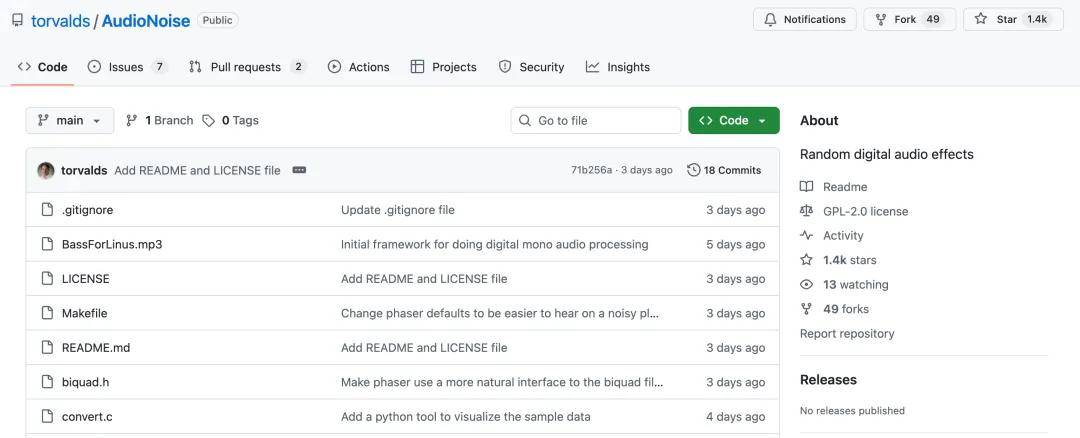
Torvalds released a new project on GitHub called AudioNoise, which is now alongside Linux in his portfolio. In the project description, he mentions that it is a codebase related to guitar effects, utilizing AI technology to “simulate cabinets”. Notably, this Python visualization tool was primarily written using Vibe Coding.

Torvalds stated that he has a much deeper understanding of analog filters than Python. Initially, he approached the project in his usual manner, searching Google and copying code, but later decided to skip the intermediary step—himself—and directly use Google Antigravity for audio sample visualization.
It seems that during the New Year holiday, Torvalds was not idle and is adapting to the latest AI trend in the tech world.
Reactions to this announcement have been mixed, with some expressing excitement: “It’s official, Vibe Coding is legitimate.”
What Did Torvalds’ First AI Project Generate?
The AudioNoise project was uploaded to GitHub five days ago and has already garnered 1.4k stars.
GitHub link: AudioNoise
According to the homepage, the AudioNoise project stems from a “random guitar effects pedal design” Torvalds worked on months ago, which includes circuit schematics and code. This is an exploration outside of the Linux kernel, aimed not at creating a finished product but at understanding principles of circuit design, such as operational amplifiers.
From the previous project, while the digital guitar pedal based on the Raspberry Pi RP2354A development board and TAC5112 audio codec operates correctly, Torvalds expressed dissatisfaction with some analog interface choices, particularly the potentiometers. He also grew increasingly frustrated with the clicking footswitch, even though it served as a programming selection switch.
Thus, Torvalds temporarily set aside hardware design to focus on physical interaction interfaces and digital sound effects. His approach was simple: “Since everything is digital, let’s start with analog and not get too caught up in hardware.”
The main design goal of this project is to learn the fundamentals of digital audio processing, aligning with his earlier intentions of learning hardware through the guitar pedal project.
The project does not involve any vocoders based on FFT (Fast Fourier Transform); instead, it features IIR (Infinite Impulse Response) filters and basic delay loops. Everything operates on a “single sample input, single sample output, and zero latency” basis. Samples may be stored in a delay loop for echo effects without complex real-time processing.
Torvalds is pleased with the TAC5112’s sub-millisecond latency performance in the ADC (Analog to Digital Converter) to DAC (Digital to Analog Converter) link and intends to continue this design philosophy. Given his lack of prior experience in this area, everything appears quite basic and simple from a novice’s perspective.
In other words, these IIR filters are not the high-end AI “cabinet simulations” found in modern pedals or guitar amplifiers. While they can simulate effects like phasers, they do so by digitally emulating RC (resistor-capacitor) networks without employing any advanced techniques.
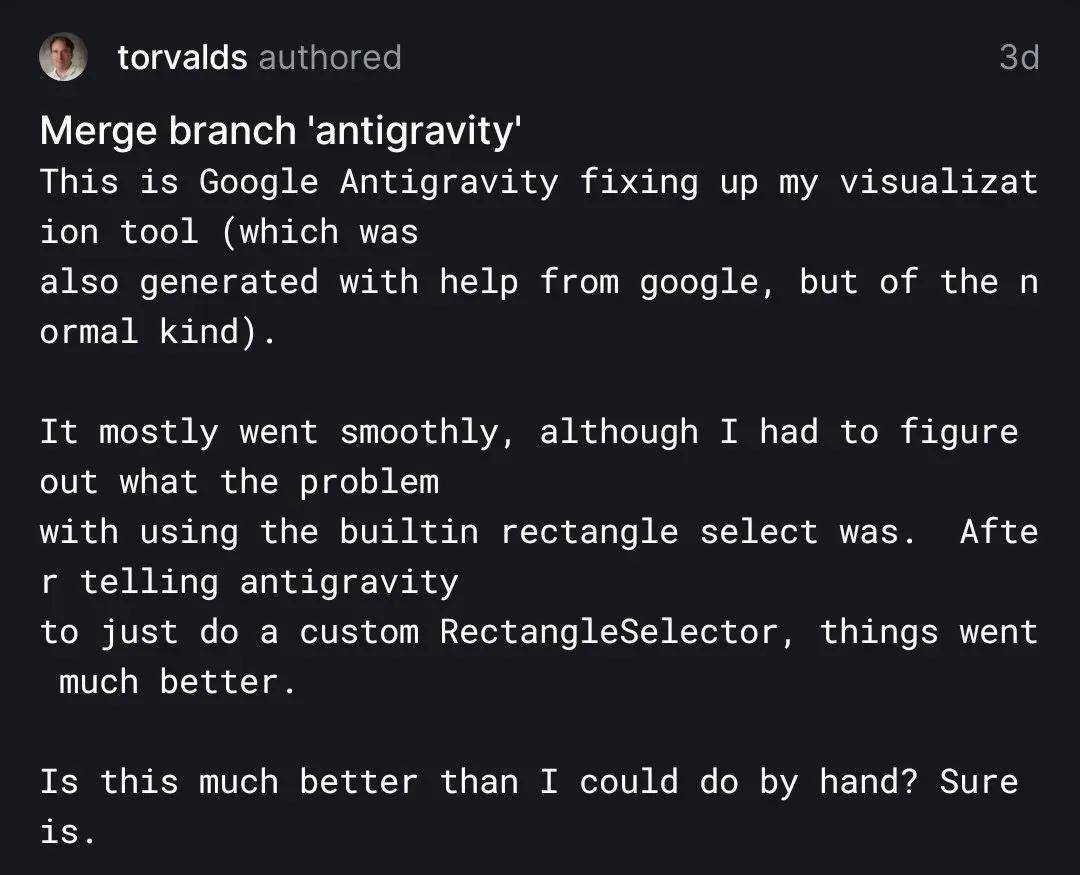
Torvalds emphasized that the Python visualization tool in the project was primarily created through “Vibe Coding”. Initially, he used a typical “search and copy” programming style but later eliminated the middleman (himself) and let Google Antigravity write the audio sampling visualization tool.
Regarding the integration of AI programming tools, Torvalds noted that the process went “smoothly”, although he sometimes had to figure out issues with the “built-in rectangle selection” feature. After instructing Antigravity to directly create a custom RectangleSelector, things improved significantly.
When asked whether Vibe Coding produced better results than his own coding, his answer was a definite yes.
The AI software development platform used by Torvalds, Antigravity, was released by Google in November last year and competes directly with Cursor. It evolves traditional AI-driven IDEs into an “agent-first” format, leveraging Google’s latest large model, Gemini 3, to enable programming agents to autonomously plan and execute complex end-to-end software tasks.

Importantly, this tool is currently free to use during its user acquisition phase.
Industry Reactions: Riding the AI Wave
Torvalds’ use of AI programming tools has sparked significant discussion in the tech community, marking a rare occurrence that many are calling a “never thought I’d see this” moment.
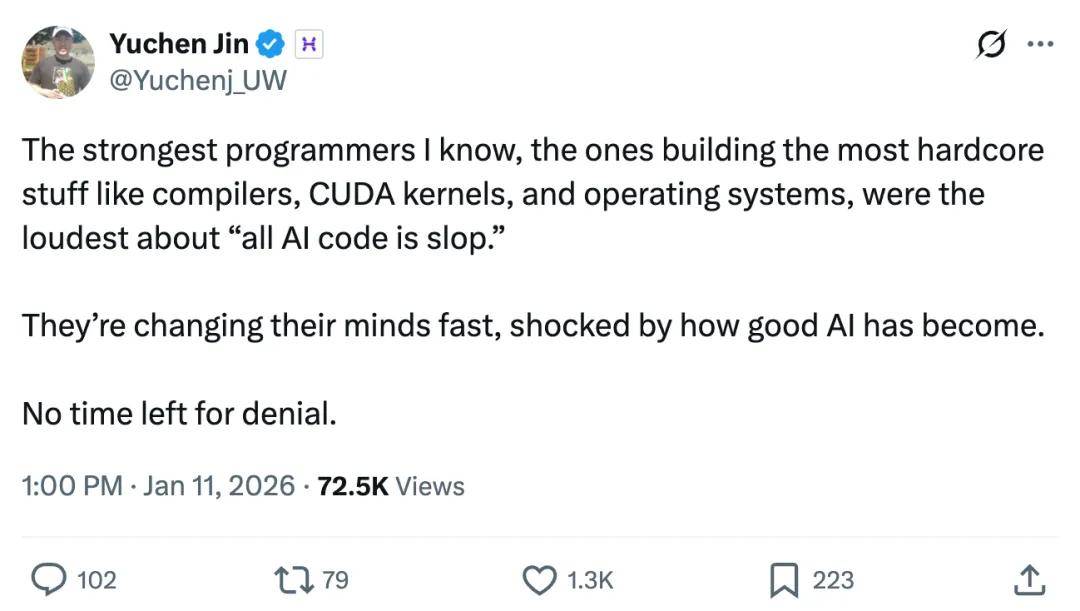
Some have remarked, “The most skilled programmers I know, including those who build compilers, CUDA kernels, and core operating system functions, were the loudest voices against ‘all AI code being garbage’. But now, their views are rapidly changing, and they are astonished by AI’s capabilities. There’s no time to deny this anymore.”
Varun Mohan, the creator of Antigravity and a Google DeepMind engineer, expressed immense honor at Torvalds using the AI programming tool in his latest project.
Guillermo Rauch, CEO of cloud development platform Vercel, listed several significant events at the start of 2026, including Torvalds using Vibe Coding in a non-kernel project, Terence Tao announcing GPT and Aristotle autonomously solving the Erdős problem, and programming guru DHH retracting his previous statement on AI not being able to code.
Just Days Ago, Torvalds Criticized AI
As a programmer who once led the industry, Linus Torvalds has maintained a relatively conservative stance on AI writing code. Until late last year, he had categorized programming into two dimensions: “beginner” and “production”.
He believes that for non-professionals, Vibe Coding is a great technology that lowers barriers, but for production environments and kernel development, Torvalds clearly stated that Vibe Coding is “a very, very bad idea—if you don’t understand the logic of the code, you can’t fix it when it crashes in production.”
Torvalds considers current AI-assisted programming to be “90% marketing and 10% reality”, expressing strong disdain for those who submit “garbage code” generated by AI to kernel maintainers.
On January 7, during a discussion among Linux kernel developers on how to regulate AI-generated Linux kernels, Torvalds interjected:
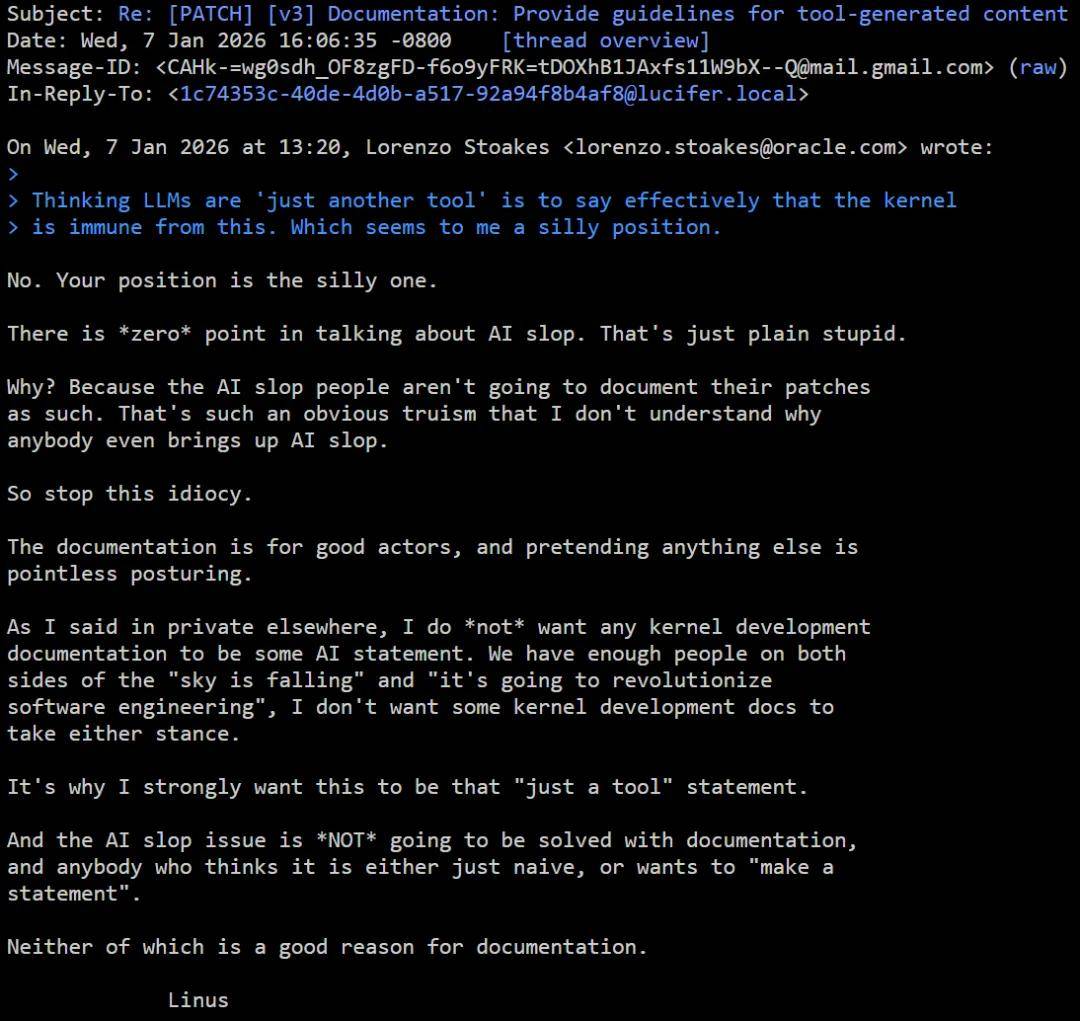
He stated, “Discussing AI-generated garbage is utterly meaningless and downright foolish. Those who generate garbage content won’t even note it in their patches. So stop this foolishness. I don’t want any kernel development documentation to include any statements about artificial intelligence.”
This aversion brings to mind his infamous gesture towards NVIDIA’s CEO.
Curiously, after his criticism, Torvalds released code he wrote using AI. Will the AudioNoise project become Linus Torvalds’ “aha moment”?
Comments
Discussion is powered by Giscus (GitHub Discussions). Add
repo,repoID,category, andcategoryIDunder[params.comments.giscus]inhugo.tomlusing the values from the Giscus setup tool.