Anthropic Shuts Down OpenClaw: A Planned Move Against Competition
On April 4, 2026, OpenClaw, an automation framework entirely generated by Claude, was abruptly shut down by Anthropic, leaving thousands of heavy users’ workflows in disarray overnight. This seemingly sudden action is rooted in economic losses, the founder’s shift to a competing platform, and Anthropic’s own business calculations regarding feature replication. This article delves into the trust crisis within the AI ecosystem and highlights collective concerns under the subscription model.

One morning, you wake up to find your workflow suddenly paralyzed. An email from Anthropic, polite yet firm, informs you that your carefully constructed AI automation system no longer belongs to you. This is not a scene from a science fiction novel; it is a reality faced by thousands of OpenClaw users on April 4, 2026.
What is OpenClaw? A Strange Story of “Building Claude with Claude”
To understand this incident, one must first grasp what OpenClaw is. Named after the claw of a lobster, it is affectionately referred to as “lobster” in the Chinese community. However, it is not an AI model but a framework—a “shell”. Users issue commands through everyday chat interfaces like WhatsApp, Discord, and Telegram, and OpenClaw quietly executes tasks on their computers: managing emails, controlling calendars, checking in automatically, reading and writing files, and executing code. One account can run ten agents continuously.
It sounds impressive, but what’s even more bizarre is how it was created. The founder, Peter Steinberger, a legendary figure in iOS development and the creator of PSPDFKit, took on the role of product manager for OpenClaw. All of OpenClaw’s code—backend, frontend, CI/CD, testing, and documentation—was entirely generated by Claude Code. Peter himself wrote not a single line of code, only describing requirements in natural language.
The underlying technology of this tool is entirely based on Claude: long context, agent tool invocation, and multi-step reasoning. From its essence to its structure, OpenClaw is a product born from Claude. A tool created by Claude, driven by Claude—this story is the best endorsement of Claude’s capabilities.
A $200 Subscription Leveraging $5000 in Value—Something Was Off from the Start
OpenClaw’s rise can be traced back to a troubling numerical logic. Anthropic’s Claude Max subscription is priced at $200/month. Under normal usage scenarios, this price covers daily conversations, coding assistance, and document processing, which seems reasonable. However, OpenClaw users are not “normal users”—they run AI for high-intensity automation tasks around the clock. Some have calculated that through OpenClaw, a $200 subscription can leverage approximately $5000 worth of computational resources.
This means that Anthropic incurs a net loss of nearly $4800 per month for each heavy user. OpenClaw’s user base consists of the most intensive users of Claude, who rely heavily on this platform for their entire workflow. Each OpenClaw user becomes a continuously operating “vampire pump” on Anthropic’s servers.
This contradiction was evident from the very first day OpenClaw gained popularity, but no one anticipated the explosion would come so quickly and decisively.
The Founder’s Move to OpenAI—The Last Straw
If the economic losses were the rationale behind the shutdown, the next event was the true catalyst for Anthropic’s decision. In early 2026, OpenAI poached Peter Steinberger.
What does this mean? A tool deeply reliant on Claude and built entirely on Anthropic’s technology stack now has its founder working for Anthropic’s most direct competitor. Anthropic faced a situation where it was subsidizing a large number of heavy users while these users were helping OpenAI employees accumulate product data, user feedback, and market influence. This is an untenable position for any company.
After the news broke, Peter left a poignant message on social media:
“Dave Morin and I tried to convince Anthropic, but we only managed to delay the inevitable by a week. The timing is ironic; they first copied some popular features into their closed framework and then shut the door on open-source software.”
No one contradicted this statement.
The Shutdown Was Not Impulsive, But a Preplanned Harvest
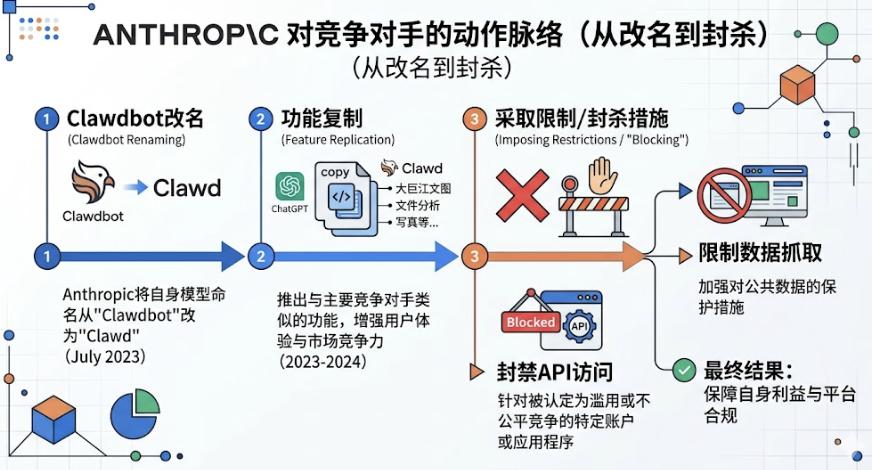
Many perceive this shutdown as a sudden policy shift. However, if you connect the events of the past few months, it becomes clear that this was a series of calculated business moves.
Step One: Trademark Pressure. OpenClaw was initially named “Clawdbot”, but Anthropic pressured for a name change due to its similarity to Claude. This was the first clear boundary set—“I allow you to exist, but you cannot grow under my name.”
Step Two: Feature Replication. In the past two months, Anthropic has released four new features, each precisely targeting OpenClaw’s core capabilities: Dispatch, which corresponds to OpenClaw’s text proxy function via WhatsApp; Claude Code Channels, which replicate OpenClaw’s Discord and Telegram controls using the MCP protocol; and enhancements to Computer Use and Claude Code, covering OpenClaw’s complete operating system access and browser control capabilities.
Step Three: Cutting Off Access. Once the in-house alternatives were essentially in place, the announcement of the shutdown followed—starting at noon Pacific Time on April 4, Claude subscription limits no longer cover any third-party tools like OpenClaw.
This sequence can be aptly summarized as: OpenClaw paved the way for Anthropic, demonstrating a real and strong demand for agent tools. Now that the path is cleared, Anthropic conveniently dismantled the bridge.
This Is Not Just About OpenClaw—A Collective Crisis in AI Subscription Models
If you think this incident only concerns OpenClaw, you may underestimate its significance. Analyst Peter Yang bluntly stated that both Anthropic and OpenAI are currently using a $100-$200/month pricing model to subsidize heavy users running multiple agents around the clock. This mirrors the strategy used by Uber and Lyft in their aggressive market capture. The results are well-known—Uber took 14 years to turn a profit after its founding, and fares nearly doubled in the following years.
As OpenAI and Anthropic approach their IPOs, once financial data becomes public, these loss-making subscription plans will be unsustainable. They will either need to raise prices, limit usage, or quietly exclude certain user categories from subsidy coverage, as was done with OpenClaw users. Who will be next?
Another analyst, Yuchen Jin, pointed out the emerging strategic divergence between the two companies: OpenAI currently has a more abundant GPU reserve and remains relatively generous towards third-party tools, while Anthropic, under computational pressure, is tightening its policies first. The outcome of this “who can hold out longer” war remains uncertain.
For well-known AI developers, this incident brings not only cost pressures but also a trust crisis. They initially chose the Claude platform partly because Anthropic appeared more willing to embrace a third-party ecosystem than its competitors. This policy shift directly undermines that perception.
Conclusion: Is Your Workflow Really Safe?
From a business logic perspective, Anthropic’s shutdown of OpenClaw is nearly flawless. Uncontrolled computational costs, the founder’s move to a competitor, and the availability of in-house alternatives all stand as solid reasons.
However, for users who have built their core workflows on OpenClaw, the impact of this email is not financial but rather existential: everything you’ve carefully constructed can be wiped out with a single notification.
This raises a critical question for every heavy AI user: when you deeply bind your workflow to a single platform, have you considered that one day it might change the rules without warning? What is your backup plan? Have you exceeded your risk tolerance in your reliance on a single platform?
The story of OpenClaw may just be the beginning.
Comments
Discussion is powered by Giscus (GitHub Discussions). Add
repo,repoID,category, andcategoryIDunder[params.comments.giscus]inhugo.tomlusing the values from the Giscus setup tool.